Sunday, December 15, 2013

Monday Matters #16


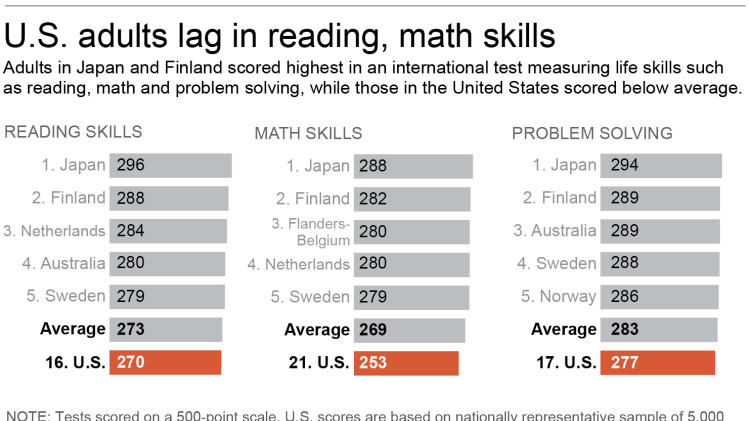
A major issue facing the United States today is education. There are many "solutions" to this issue, but they always face opposition. The government has tried to take matters into their own hands, but their ideas are put down and are said to be flawed. The problem becomes even more prevalent when you look at our international test scores compared to other industrialized countries. We consistently rank in the bottom half in Math, and do mediocre in Reading. Some people even go further to say that there is a difference in academic achievement between poorer and wealthier families. Students who attend more selective schools tend to get a higher entry level salary than those who would have gone to an ordinary college. There are also studies that show if you were to go to a college known for, say, producing lawyers, you would have a better chance of getting a job as a lawyer than somebody who went to an ordinary college. There are many factors that come into play when education is discussed. It is not something that you can look at in one dimension. This issue can not be solved with a simple solution, because it is not a simple issue. Instead of all arguing over what should be done, we need to realize that we are all a part of this country, and that we are all responsible for what happens to it. We need to come together and create a solution that incorporates everyone's ideas as much as possible. Maybe then someday we can move forward and hope to establish ourselves as an elite country when it comes to education.


Sunday, December 8, 2013

Monday Matters #15


Link: http://www.theatlantic.com/education/archive/2013/12/graph-countries-with-higher-math-scores-have-unhappier-kids/282001/
Source: The Atlantic
Author: Derek Thompson

This article talks about the recently published scores of a recent international test that was given to teenagers to test them on different subjects. The article specifically focuses on the Math scores. The United States ranked under the average, while Korea scored the highest. Indonesia scored the second lowest. But the article focuses on the how each countries score relates to the student's happiness in class. While Indonesia scored the second lowest, they reported being the happiest in school out of all the countries. Korea, while scoring the highest on the test, reported having the least happy students out of all of the countries. The author makes a connection between Math and Happiness. He concludes that the better you do on the math portion of the test, the more likely you are of being less happy at school. Having better scores on the math tests takes work, and the author says that after all, they are still kids, and kids do not like working harder than they have to.


Sunday, December 1, 2013

Monday Matters #14

Link: http://www.nytimes.com/2013/12/02/world/europe/measuring-the-wealth-effect-in-education.html?ref=education&_r=0
Source: New York Times
Author: D. D. Guttenplan

Guttenplan talks about the differences in academic achievement between poorer working class families and professional wealthier families in Britain, Australia, and the United States. The information and statistics come from Dr. John Jerrim. He explains that students who attend a more "selective" university on average get a higher entry level salary than those who would have gone to an ordinary college. He also goes onto say that certain universities catch the eyes of elite job recruiters in certain fields. So if you were to go to a college known for producing lawyers, you would have a better chance to get a job as a lawyer than somebody who went to an ordinary college. In the United States, social background also plays a role in getting into the college you want. Since public schools are funded by local property taxes, students of a more disadvantaged area often are overshadowed by students living in a more wealthy area. Academic achievement also contributes to the gap between the wealthier and the poorer at certain colleges. In the United States, 60% of the admission gap between wealthier and poorer students can be traced back to academic achievement in grade school.


Sunday, November 24, 2013

Monday Matters #13


Link: http://www.huffingtonpost.com/2013/11/21/school-improvement-grants_n_4318236.html?utm_hp_ref=education&ir=Education

By: Joy Resmovits, The Huffington Post

The federal government has invested around 4.6 million dollars to improve the low scoring schools in the country. There are four options for schools, closing them, becoming a charter school, shifting the curriculum, or replacing staff. The goal is to raise scores for students and to prepare them for college and a career. Some are scoring higher than before; becoming more proficient in math and reading. The problem is, a third of the schools that are receiving these grants are actually scoring lower than before. Duncan, the U.S. Secretary of Education, still has faith, saying that we need to help these schools (the bottom five percent in the nation) in any way we can, and that change is incremental. Duncan believes these grants will work, we just need to give it time. Duncan says the key for a good school is a good principal who knows how to form this great curriculum and teachers that want to carry out this plan.


Monday, November 18, 2013

Monday Matters #12


A lot of the arguments for both sides of the controversy were very similar. We should make a change to our school calendar. The scores our students are getting is not acceptable; if we want to be a global super power, we are going to need to educated people to represent this country. We consistently rank below other countries in subjects like math, reading, and science. In order to better prepare our young people for these tests, we need to make their time in the classroom worth while. Making changes to the calendar doesn't mean students will be in school longer. Just that when they are not in school, they can learn other things that can help them in the future, instead of doing other things like playing video games all day. Another thing that would benefit the students in the calendar change is that the breaks would be less spaced out, so that when they return they do not forget as much material as the three month summer break. Lastly, the the extended school calendar will allow students to learn more material, better preparing them for standardized tests and the real world. We need to stay ahead of the pack when it comes to education, and the method we are using right now just does not work. If we are going to be a competent independent nation, we need educated people, and that starts with success in the classroom.


Monday, November 11, 2013

Monday Matters #11


"Year-round school bad idea for students" By: Julia Sines, Pantagraph.com
"Year-round School Is A Good Idea" By: Andy Rooney, Chicago Tribune

Source 1 argues that if the school year is extended to the point of getting rid of summer vacation, students would be less motivated in attending school on a regular basis and would lead to more high school drop outs. Then there is the summer activities. Lots of kids like to play sports in the summer and families like to go on summer vacation trips, and they would not be able to do that with the new school calendar. Source 1 even argues that the students now work hard for those eight months, and they deserve a break. There is also the problem of students getting summer jobs to save up money for college. They would also lose out on working experience. The article ends with that many schools would not be able to afford to stay open during the summer with the cost of air conditioning. So students would have to work in the heat; not a good environment for learning.

Source 2 starts off by saying that if we can develop our intelligence, it is our obligation to. Intelligence is key to our future as a country and we need keep up with the rest of the world. Source 2 then goes on to say that we pay money for these schools to stay open; wouldn't it be a good idea to keep them open year-round? Source 2 compares schools to libraries and hotels, that they wouldn't close for three months. There would be vacations, just not as long. It ends with saying that if intelligence is what we are striving for, for need to rethink the way we run our school system.


Sunday, November 3, 2013

Monday Matters #10

Source 1: Year-Round School? My Kids Love It. Yours Will, Too. By: Brigid Schulte
Source 2: To Fix Education, School Hours and Money Need to Be Better Spent By: Frederick Hess

Source 1 talks about her life as a mother having her kids in a year-round school year. She says her kids have benefited from the calendar by learning much more things than kids in schools with a traditional calendar. During these breaks or "intersessions", kids have the option to enroll in fun classes that teach interesting things, like karate or photography. By enrolling in these classes, children can try knew things and hopefully in the future find something they would want to pursue as a career. Source 2 argues that it is not the the school calendar that is in need of change, it is the quality of our teachers and the way they use the time in the classroom is what needs to be monitored. Source 1 says that vacation time could be swapped out with intersession. This gives families more flexibility when it come to vacation and what time of year to go. Source 2 fires back by saying that the longer school year will just be a waste. The cost for the schools to stay open that long will raise. Also, if the teachers students have now are not good quality, what will lengthening the school year do? Source 1 raps up with saying that if we lengthen the school calendar  kids in kindergarten now, by fifth grade, will have received a whole extra year of schooling. This can help the advancing new world we live in and keep our children competitive with the rest of the world. Source 2 says instead of just lengthening the school year hoping for the best and completely ignoring the money issues, we should make sure that the teachers we have now are quality teachers that use their time in the classroom efficiently before making such radical decisions.