Sunday, April 6, 2014

Monday Matters #29


All the articles I covered had to do with Psychology. One common theme is gender equality. Whether it is at school with certain genders performing better at certain classes than the other, or in the work place arguing for equal pay for equal work, how the genders are treated and taught is something that Psychologists are trying to dissect. Is it a subconscious way of thinking? Or can expectations be changed? This is a primary issue with this community. Another issue Psychology likes to evaluate are mental disorders and how they affect peoples' lives. A good example of this is my post on Kurt Cobain's death 20 years ago. They evaluated his mental state and how that lead to killing himself. I would be very interested in exploring how people think and why they act the way they do. I would use this to try to help people and prevent them from making the wrong decisions in their lives. I would be interested in majoring in Psychology in college, specifically working for the police to try to evaluate criminals and certain investigations. I feel like I am a very good judge of character, and can read people very well. This field of study would suit me nicely, and eventually I would hope to make a successful career of this.




Monday, March 31, 2014

Monday Matters #28


Link: http://www.psychologytoday.com/blog/crime-she-writes/201403/police-new-photos-prove-grunge-singers-death-suicide-0

This article talks about police in Seattle reopening the case regarding Kurt Cobain's alleged suicide on April 5th, 1994. The police decided to reopen the case to prove it was a suicide so that people would not bring up conspiracy theories on the 20th anniversary of his death. Also, there was a roll of underdeveloped photos that some claimed to overlook some evidence to suggest a murder and not a suicide. Police did their investigation and it was ended very quickly. They say there is not doubt that Cobain shot himself with a shotgun on that day while having a high concentration of heroine in his body. There was also a cigar box with drug paraphernalia to suggest this. Cobain struggled with drug addiction, depression, and even wrote a handwritten suicide note to suggest he killed himself. Police assure that there is no evidence of foul play.


Monday, March 24, 2014

Monday Matters #27


Link: http://www.theguardian.com/education/2014/mar/18/girls-physics-boys-other-subjects-gender-disparity

This article explains the gender differences between girls and boys in the area of physics. While boys account for half of all A-level physics students, girls only account for a quarter. The speaker is a female science teacher, and is disappointed at the fact that while this is true, boys also are falling behind in English behind girls. She believes that people should not just focus on getting girls interested math, but also on boys. She believes sticking a girl on a poster promoting girls getting into the sciences won't do the trick. There needs to be equal focus on boys and girls when it comes to academic performance. She ends with saying we need to change the mentality of both genders when it comes to academics. A male students should not feel he shouldn't do well in a subject because only girls do well or like the class, and vice versa. Ultimately, we need to strengthen students' confidence in themselves.


Sunday, March 16, 2014

Monday Matters #26


Link: http://esciencenews.com/articles/2014/03/05/womens.jobs.are.poorer.paid.less.flexible.and.more.stressful

This article is about how studies have shown that women's working conditions and opportunities lag behind that of men's. According to a survey conducted about the occupations of men and women, Men consistently score better when it comes to stress, flexibility in schedule, wages, and promotion opportunities. These results invalidate the thought that women have on average lower paying jobs and lower promotion opportunities because of their responsibilities at home. There seems to be a trend in that women do not enjoy their jobs as much as men, and that they feel that cannot move up in position as easily as men. The studies also show women's resentment for lower salaries fro the same amount of work. Yet, this does not reflect the women's lack of achievement, the study claims. Lastly, the study also found that the more women working in a certain area of work, the more comparable the working conditions are with that of men in the same area.


Sunday, March 9, 2014

Monday Matters #25


Link: http://www.sociologytimes.com/research/Study_shows_mentally_ill_more_likely_to_be_victims_not_perpetrators_of_violence.asp

This article talks about the correlation between the mentally ill and violence. While many seem to believe that the mentally ill are the perpetrators of violence. Studies from the North Carolina State University propose that a high number of violent adults that are mentally ill are also victims of violence. Also, a high number have reported to have been treated violently on multiple occasions. The article also reports that the mentally ill are 11 times more likely to be violent if they have been victims to violence. The article ends saying that we need  to not only help the mentally ill from being violent, but also helping them by protecting them from being victimized by other people. This in turn, according to their studies, would lower the amount of violence coming from mentally ill adults.


Sunday, February 16, 2014

Monday Matters #24


The policies President Obama addressed in his State of the Union speech had a lot of things I agree with. The article talks about Obama addressing alternative energy. I completely agree with this point, mostly because I want the United States to break its dependency on foreign oil. They said we need to create more jobs, and prepare these people for those jobs. I agree with this as well; I feel that Americans are not fully prepared to contribute positively in society, so helping them be prepared is a good idea.  Another article says we need cheap energy, suggesting we keep importing oil. I disagree with this because it goes against my views that I have expressed above. The same article suggests we follow the first amendment more closely. I feel we should not. This being a radical idea, I feel that we as a country need to "update" the constitution in order to properly reflect the society of today. 


Sunday, February 9, 2014

Monday Matters #23


The last two posts, one by liberals and one by conservatives, propose issues and important things that each think President Obama should mention in his State of the Union address. All of these suggestions from both sides are backed up by factual information, so there are not any assertions made that are not backed up by facts. There are, however, different points proposed by each side that they think Obama needs to address. The conservatives say that we need to stop the war on coal and have affordable energy readily available, while the liberals want coal out, and want the USA to find alternative energy sources to help the environment. The conservatives are really concerned with the education of our country, and with keeping the federal government out of peoples' lives as  much as possible. Oppositely the liberals are more concerned with creating jobs, economic and political populism, and strict gun control laws. These two political philosophies each have a different idea on how to improve our country, and they would argue that their respective ideas are the best. Both would agree on helping the middle class, but they have different ideas about how to accomplish this.


Saturday, February 1, 2014

Monday Matters #22


Link: http://www.thenation.com/slideshow/157998/slide-show-7-ways-obamas-state-union-can-save-his-presidency

This article by The Nation explains what should be included in President Obama's State of the Union address in order to save his presidency. The first point made is to focus on creating jobs. America wants jobs and we cannot obsess over the Federal deficit. The second point explains that creating jobs is not enough, we also need to get Americans back to work. Obama needs to lay out a plan to carry this through. The article goes on to talk about how the president needs to get rid of the perception that he is in "big business's pocket" and help reclaim economic populism. The next point explains why the Obama administration needs to help struggling homeowners. His approach to this is widely viewed as ineffective, so he needs to approach this issue differently. Another point is that he needs to protect medicare and social security. Many people need this and it is his responsibility to protect it. Next, it explains that Obama needs to push for sensible gun control. This should also receive bipartisan support, so this needs to be addressed. The last point given is that Obama needs to address climate change. The sooner congress recognizes this problem, the more prepared the USA will be for the "new energy economy".


Tuesday, January 28, 2014

Monday Matters #21


Link: http://blog.heritage.org/2014/01/28/7-things-late/?utm_source=heritagefoundation&utm_medium=homepage&utm_campaign=headline140128

The people at Heritage have some ideas for President Obama and Congress to address at the State of the Union address tonight. They list them in points, having seven of them. The article starts off by saying that we need to save Americans from the skyrocketing energy bills by reversing the war on coal and having affordable energy readily available. The article then goes into proposing the idea of letting students succeed in schools of their choice. It shows that the Capital's scholarship program is not useful, and that when parents choose the schools students succeed, because school choice works. The third point suggests that the government serve the people by allowing more state's rights. They give gay rights as an example, that the federal government should stay out of it and let each state figure it out for themselves. The fourth point is saying to start moving forward on entitlement reform. America's spending causes us to go into debt, and it drags down the economy. They also suggest some type of controlled spending. The fifth point made says we should be ready for anything. We need to be ready for anything, mostly militarily. The sixth point encourages we follow the first amendment. We need to allow a little bit more freedom when it comes to health care and religious liberty. Finally, the last point made proposes we stop the food policies that hurt the poor. The farm policies we have now boost food prices. The government should stay out of the food supply.


Monday, January 20, 2014

Monday Matters #20


Link: http://www.ted.com/playlists/125/tv_special_ted_talks_educatio.html

Angela Lee Duckworth was a management consultant and became what she believed was an even more demanding job, being a teacher. She taught seventh grade math and did everything a normal teacher would do like make tests and grade homework. She noticed her better students were not always the students with the highest IQ, and that some students with the highest IQ were not doing all too well in her class. She claims our educational system can measure IQ very well, but fails to promote the motivational side of learning. She then became a physiologist to figure out the keys to success. After studying many kids and adults in different settings, she concluded that "grit" was what many successful people had in common, not IQ. Passion and perseverance is what helped these people accomplish their long term goals. She backed up her claim with research she conducted in the Chicago Public School area, and it was successful. She ends with promoting "growth mindset" developed at Stanford University that tries to teach children about how to persevere through school and addresses that hard work can get you far.


Sunday, January 12, 2014

Monday Matters #19


Link: http://sirkenrobinson.com/?p=744

This blog post talks about how creativity can influence or inspire people to do different things. He gives an example, the iPhone, and how that the innovative device five years later can now be used as a virtual harmonica. Robinson explains that our own creativity is a part of a much larger cultural conversation. Our ideas lead to another person's ideas and so on. This creates a giant pool of ideas for us to see and share with each other. Sometimes this inspiration comes from something related to what you do, sometimes it can be completely different. This creativity is essential when it comes to schools promoting creativity and innovation. Students need inspiration, which today many students lack. Robinson ends with showing us examples of how he has inspired other people, and by saying that this cultural conversation can lead to many new innovations.


Tuesday, January 7, 2014

Monday Matters #18


Link: http://dianeravitch.net/2014/01/07/is-san-diego-the-best-urban-district-in-the-nation/

This article Diane Ravitch wrote is her explaining why she thinks San Diego has the best urban district in the nation when it comes to education and community. The teachers and administrators are all working towards a common goal, to improve the future generations. She says her opinion is not based on test scores, even though they are improving, but on the climate of teaching they have. Back in the 1990's, San Diego had its problems in the educational department, but now things are changing. The previous superintendent, Mr. Kowba, had a different idea of improvement. He valued teamwork and community to help the teachers and the union come together. Test scores went up, with the new spirit of teamwork between students, teachers, parents, and the local community. The board voted for a new superintendent once Kowba retired, and Cindy Marten has filled in his spot perfectly. She inspires and also values community involvement. Yet, a newspaper still seems to believe that the San Diego urban district is failing, saying they should bring back older superintendents, especially the one now in Houston, Texas. Ravitch counters with her logos by showing that Houston has a higher drop out rate and lower test scores. She finishes by saying that San Diego has the perfect line up. It has a great intelligent superintendent that gets the community involved. The cohesion of the parents, students, union, and the board is also impressive. And they all have one goal in common, to improve the education for every child. It is all about the children.


Monday Matters #17


Link to picture: http://www.grandparents.com/grandkids/discipline-and-behavior/discipline-proof

This image properly illustrates what children need these days. In order for all these plans to improve the USA's educational system to work, they are going to need the cooperation and help of parents. Parents, as of recently, have had a hard time disciplining their children. These children grow up thinking they can do whatever they want and get away with it, so that is what they do. Growing up this way causes them to think that they cannot be told what to do or forced to do anything. They defy their parents and any other older figures. When they get into school, these children think if they do not have to listen to their parents, why should they listen to a teacher? Most of these children most likely are not too interested in doing well in school in the first place, and with the upbringing they had, they are set up to fail in school. The picture also shows a child pouting, which illustrates the idea of children defying their parents' scolds. The upbringing of a child plays an important role in their academic performance. We need to bring up children that see the value in education and want to strive to do their best on their own. We need children who want to invest in a successful future.

Sunday, December 15, 2013

Monday Matters #16


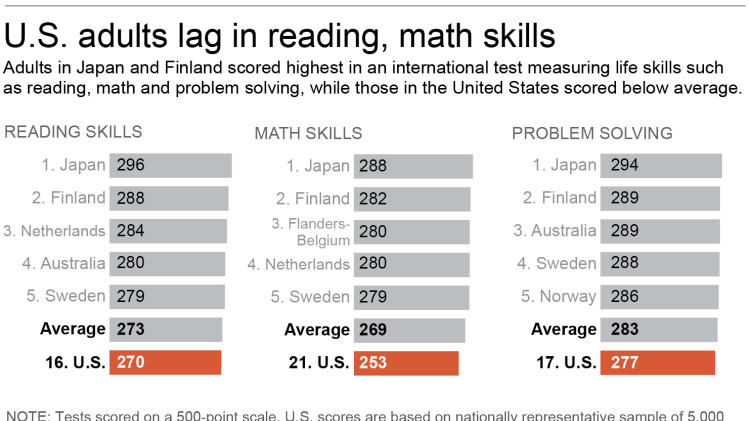
A major issue facing the United States today is education. There are many "solutions" to this issue, but they always face opposition. The government has tried to take matters into their own hands, but their ideas are put down and are said to be flawed. The problem becomes even more prevalent when you look at our international test scores compared to other industrialized countries. We consistently rank in the bottom half in Math, and do mediocre in Reading. Some people even go further to say that there is a difference in academic achievement between poorer and wealthier families. Students who attend more selective schools tend to get a higher entry level salary than those who would have gone to an ordinary college. There are also studies that show if you were to go to a college known for, say, producing lawyers, you would have a better chance of getting a job as a lawyer than somebody who went to an ordinary college. There are many factors that come into play when education is discussed. It is not something that you can look at in one dimension. This issue can not be solved with a simple solution, because it is not a simple issue. Instead of all arguing over what should be done, we need to realize that we are all a part of this country, and that we are all responsible for what happens to it. We need to come together and create a solution that incorporates everyone's ideas as much as possible. Maybe then someday we can move forward and hope to establish ourselves as an elite country when it comes to education.


Sunday, December 8, 2013

Monday Matters #15


Link: http://www.theatlantic.com/education/archive/2013/12/graph-countries-with-higher-math-scores-have-unhappier-kids/282001/
Source: The Atlantic
Author: Derek Thompson

This article talks about the recently published scores of a recent international test that was given to teenagers to test them on different subjects. The article specifically focuses on the Math scores. The United States ranked under the average, while Korea scored the highest. Indonesia scored the second lowest. But the article focuses on the how each countries score relates to the student's happiness in class. While Indonesia scored the second lowest, they reported being the happiest in school out of all the countries. Korea, while scoring the highest on the test, reported having the least happy students out of all of the countries. The author makes a connection between Math and Happiness. He concludes that the better you do on the math portion of the test, the more likely you are of being less happy at school. Having better scores on the math tests takes work, and the author says that after all, they are still kids, and kids do not like working harder than they have to.


Sunday, December 1, 2013

Monday Matters #14

Link: http://www.nytimes.com/2013/12/02/world/europe/measuring-the-wealth-effect-in-education.html?ref=education&_r=0
Source: New York Times
Author: D. D. Guttenplan

Guttenplan talks about the differences in academic achievement between poorer working class families and professional wealthier families in Britain, Australia, and the United States. The information and statistics come from Dr. John Jerrim. He explains that students who attend a more "selective" university on average get a higher entry level salary than those who would have gone to an ordinary college. He also goes onto say that certain universities catch the eyes of elite job recruiters in certain fields. So if you were to go to a college known for producing lawyers, you would have a better chance to get a job as a lawyer than somebody who went to an ordinary college. In the United States, social background also plays a role in getting into the college you want. Since public schools are funded by local property taxes, students of a more disadvantaged area often are overshadowed by students living in a more wealthy area. Academic achievement also contributes to the gap between the wealthier and the poorer at certain colleges. In the United States, 60% of the admission gap between wealthier and poorer students can be traced back to academic achievement in grade school.


Sunday, November 24, 2013

Monday Matters #13


Link: http://www.huffingtonpost.com/2013/11/21/school-improvement-grants_n_4318236.html?utm_hp_ref=education&ir=Education

By: Joy Resmovits, The Huffington Post

The federal government has invested around 4.6 million dollars to improve the low scoring schools in the country. There are four options for schools, closing them, becoming a charter school, shifting the curriculum, or replacing staff. The goal is to raise scores for students and to prepare them for college and a career. Some are scoring higher than before; becoming more proficient in math and reading. The problem is, a third of the schools that are receiving these grants are actually scoring lower than before. Duncan, the U.S. Secretary of Education, still has faith, saying that we need to help these schools (the bottom five percent in the nation) in any way we can, and that change is incremental. Duncan believes these grants will work, we just need to give it time. Duncan says the key for a good school is a good principal who knows how to form this great curriculum and teachers that want to carry out this plan.


Monday, November 18, 2013

Monday Matters #12


A lot of the arguments for both sides of the controversy were very similar. We should make a change to our school calendar. The scores our students are getting is not acceptable; if we want to be a global super power, we are going to need to educated people to represent this country. We consistently rank below other countries in subjects like math, reading, and science. In order to better prepare our young people for these tests, we need to make their time in the classroom worth while. Making changes to the calendar doesn't mean students will be in school longer. Just that when they are not in school, they can learn other things that can help them in the future, instead of doing other things like playing video games all day. Another thing that would benefit the students in the calendar change is that the breaks would be less spaced out, so that when they return they do not forget as much material as the three month summer break. Lastly, the the extended school calendar will allow students to learn more material, better preparing them for standardized tests and the real world. We need to stay ahead of the pack when it comes to education, and the method we are using right now just does not work. If we are going to be a competent independent nation, we need educated people, and that starts with success in the classroom.


Monday, November 11, 2013

Monday Matters #11


"Year-round school bad idea for students" By: Julia Sines, Pantagraph.com
"Year-round School Is A Good Idea" By: Andy Rooney, Chicago Tribune

Source 1 argues that if the school year is extended to the point of getting rid of summer vacation, students would be less motivated in attending school on a regular basis and would lead to more high school drop outs. Then there is the summer activities. Lots of kids like to play sports in the summer and families like to go on summer vacation trips, and they would not be able to do that with the new school calendar. Source 1 even argues that the students now work hard for those eight months, and they deserve a break. There is also the problem of students getting summer jobs to save up money for college. They would also lose out on working experience. The article ends with that many schools would not be able to afford to stay open during the summer with the cost of air conditioning. So students would have to work in the heat; not a good environment for learning.

Source 2 starts off by saying that if we can develop our intelligence, it is our obligation to. Intelligence is key to our future as a country and we need keep up with the rest of the world. Source 2 then goes on to say that we pay money for these schools to stay open; wouldn't it be a good idea to keep them open year-round? Source 2 compares schools to libraries and hotels, that they wouldn't close for three months. There would be vacations, just not as long. It ends with saying that if intelligence is what we are striving for, for need to rethink the way we run our school system.


Sunday, November 3, 2013

Monday Matters #10

Source 1: Year-Round School? My Kids Love It. Yours Will, Too. By: Brigid Schulte
Source 2: To Fix Education, School Hours and Money Need to Be Better Spent By: Frederick Hess

Source 1 talks about her life as a mother having her kids in a year-round school year. She says her kids have benefited from the calendar by learning much more things than kids in schools with a traditional calendar. During these breaks or "intersessions", kids have the option to enroll in fun classes that teach interesting things, like karate or photography. By enrolling in these classes, children can try knew things and hopefully in the future find something they would want to pursue as a career. Source 2 argues that it is not the the school calendar that is in need of change, it is the quality of our teachers and the way they use the time in the classroom is what needs to be monitored. Source 1 says that vacation time could be swapped out with intersession. This gives families more flexibility when it come to vacation and what time of year to go. Source 2 fires back by saying that the longer school year will just be a waste. The cost for the schools to stay open that long will raise. Also, if the teachers students have now are not good quality, what will lengthening the school year do? Source 1 raps up with saying that if we lengthen the school calendar  kids in kindergarten now, by fifth grade, will have received a whole extra year of schooling. This can help the advancing new world we live in and keep our children competitive with the rest of the world. Source 2 says instead of just lengthening the school year hoping for the best and completely ignoring the money issues, we should make sure that the teachers we have now are quality teachers that use their time in the classroom efficiently before making such radical decisions.